
How to Play Dominus Gladiatus: Core Loop Explained
Learn how to play Dominus Gladiatus: the day tick, Ludus tabs, training, fatigue, arena scheduling, crowd calls and the 165-day campaign loop.
To play Dominus Gladiatus, run a Ludus for 165 days: buy slaves, train skills, manage Fatigue, injuries and morale, then schedule arena fights that pay enough to cover upkeep. Fights resolve automatically. Your real inputs are the roster, the training plan, the equipment and the two crowd calls you make before and during a bout.
The first hour feels like menu work because most systems are hidden behind tabs. This page walks the loop in the order the game introduces it, then shows where each decision feeds the next.
What does a normal day look like?
Time only moves when you commit an activity. Opening the Ludus, reading a gladiator card or browsing the market does not advance the clock. Training blocks, Infirmary stays, building construction and arena trips do.
A typical day has four checkpoints:
- Read the Ludus header. Coins and the current day are always visible. The GENERAL tab states the upkeep rule: 1 coin per day plus 1 coin for each gladiator you own.
- Check each fighter's INFO card. Fatigue should be below 3 before an arena booking. Injuries block training and fighting. Morale warnings appear here before they become refusals.
- Commit training or recovery. Training takes 2-3 days for early skill ranks. Quarters and the Pleasure House restore Fatigue and morale while the calendar advances.
- Schedule or skip the arena. The fight card shows the city, rules, purse, crowd mood and days until the bout. You can decline a contract without advancing time.
The day tick is the real difficulty slider. A player who checks Fatigue before booking will beat a player with better equipment who books on a whim.
Official source: Dominus Gladiatus store page ↗
Which tabs matter and when?
The top bar has five tabs: GENERAL, INFO, BUILD, STAFF and ARMY. Each answers a different question.
| Tab | What it answers | When to open it |
|---|---|---|
| GENERAL | Upkeep, day count, slave market access | Start of every session |
| INFO | Health, Fatigue, morale, talents, skills, equipment | Before every booking |
| BUILD | Quarters, Infirmary, Palus, Pleasure House, Temple | When a bottleneck appears |
| STAFF | Doctore, Procurator, Venator, Faber, Agent, Ordinator | When coins allow a permanent hire |
| ARMY | Full roster and current assignments | When planning the next block |
INFO is the tab beginners skip. It contains the two numbers that decide fights: Fatigue and Health. It also shows talents such as Fast Learner or Rapid Recovery, the Freedom Goal victory count, temperament and the current high-morale or low-morale trait.
The BUILD tab is not a city builder. Each building removes one specific bottleneck: Quarters for Fatigue, Infirmary for injuries, Palus for training speed, Pleasure House for morale, Temple for prayer. Buy the bottleneck you actually have.
A 60-coin Palus that saves two training days per skill rank is cheaper than a 40-coin weapon that adds a few points of damage. Buildings compound; gear depreciates when the gladiator dies.
How does training work?
Training is a calendar commitment. You pick a skill, pay the training time, and the gladiator improves when the block finishes. Early Combat ranks take about 3 days; some utility skills take 2. The Palus raises training speed by 20%, and the Doctore pushes training further through discipline and the lash.
Arena fights can add progress to the currently trained skill: up to 10% on a win and 15% on a loss. They cannot finish a rank. If a skill needs 100% and you are at 95%, you still need a training block in the Ludus.
That rule prevents the obvious exploit of farming arena fights to max every skill. It also means a fighter who is "almost leveled" should stay home and train instead of taking a risky purse.
The training system guide → covers skill slots, training times, the Doctore's whip and the Palus math.
How do Fatigue, injuries and morale interact?
These three systems are one loop, not three separate bars.
- Fatigue runs 0-5. A win adds 1, a loss adds 2. At Fatigue 3 the arena injury chance is 25%, at 4 it is 50%, and at 5 it is 100% according to the Patch 3 notes.
- Injuries are revealed when the gladiator returns to the Ludus. The Infirmary removes them over time. Leaving early removes only the injuries covered by the time served and restores Fatigue to its pre-admission value.
- Morale affects training speed and behaviour. High morale can unlock positive traits; low morale causes theft, refusal to fight and a suicide risk that rises over several days.
A tired fighter is also a morale risk, because losses and deaths damage the whole Ludus. The cheapest way to protect morale is to stop booking Fatigue-4 fighters for 40-coin purses.
Patch 3 states a 100% arena injury chance at Fatigue 5. There is no lucky roll. Rest the fighter or accept that the injury is the price of the purse.
How do arena fights actually play out?
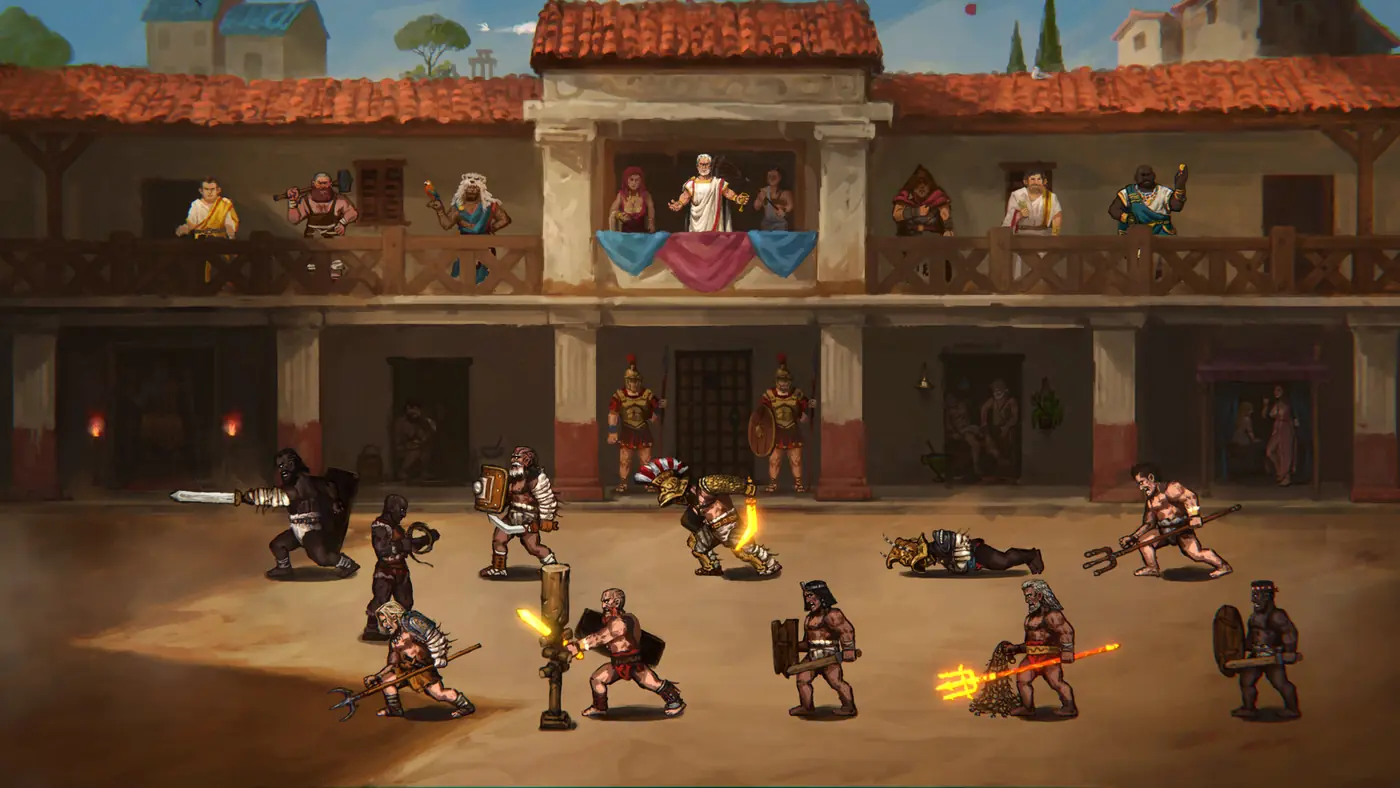
You choose a contract from the arena screen. The card lists the city, the rules (Until Surrender or To the Death), the purse and the crowd mood. The enemy tooltip shows class, Health and traits before you accept.
Once the fight starts, the gladiators act automatically. Your input is the crowd call. You get two calls per match. A Liked crowd helps on both calls, an Indifferent crowd helps once, and a Disliked crowd helps on neither. Help can mean stones thrown at your opponent or food thrown to boost your fighter, depending on the momentum.
On Ruthless, the crowd starts Indifferent or Disliked and never at Liked. That removes the reliable crowd-call swing and makes class matchups and raw stats more important.
The arena readiness checklist → lists the pre-fight checks in order.
What should you do in the first ten days?
The short version: buy one or two healthy recruits, build the Quarters, start a training block, and take only winnable fights.
Longer version:
- Do not buy every cheap slave. Each one adds 1 coin per day to upkeep and competes for training time.
- Prioritise Base Health over a flashy talent in the first market. A 115 Health recruit survives mistakes; an 85 Health project does not.
- Build Gladiator Quarters (30 coins) before your first Fatigue-3 fighter.
- Hire the Doctore (80 coins) once training, not survival, is the bottleneck.
- Add the Palus (60 coins) before you start a second combat skill.
- Keep at least 30 coins in reserve for an Infirmary stay you did not plan.
What is the actual win condition?
The campaign runs 165 days against six rival Domini and ends at the Grand Tournament Final. You need a roster that can survive the bracket, not a single unbeaten champion. After the final, the Day 1 update opens repeatable arena contracts, so the save can continue.
Two habits carry the whole run: keep two credible fighters rather than one carry, and enter every milestone with Fatigue and morale headroom. Everything else is optimisation.
Official source: Dominus Gladiatus achievements ↗
Official source: Steam news ↗
FAQ
Is there manual combat? No. Dominus Gladiatus is an auto-battler. You control preparation, match selection and crowd calls.
Can I pause the day counter? The Ludus can be paused for menu work. Time advances when you commit training, recovery, construction or arena travel, not while you read screens.
Do I lose the game if I run out of coins? The Day 1 notes say Cassius's tax can put you into debt rather than forcing an immediate forfeit. Debt is still a warning sign; cut roster size or take safer purse fights.
Does the game support a controller? Yes. Patch 6 added full gamepad support and Steam Deck layout, and the store lists full controller support.
More Dominus Gladiatus Guides
Dominus Gladiatus best build guide: Health vs damage, skill order for Murmillo, Secutor and Scissor, Veteran bonuses, equipment priorities and team-fight roles.
Dominus Gladiatus best gladiators tier list: Health, talents, temperament and class value, plus when to buy, keep or sell a recruit from the Slave Market.
Dominus Gladiatus class guide: Murmillo, Secutor and Scissor strengths, skill synergies, Retiarius and Hoplomachus matchups, and the best first class.
How crowd favor works in Dominus Gladiatus: Liked, Indifferent and Disliked calls, two calls per fight, stones and food, favored immunity and Ruthless rules.
All six Dominus Gladiatus Domini: Titus Aurelian, Khepri Setekh, Cassius Lysandros, Aurelia Zahara, Livia Calpurnia and Decimus Amborix, powers and counterplay.
Twelve Dominus Gladiatus tips that prevent early run deaths: fatigue management, market discipline, morale warnings, crowd calls and upkeep traps.
How Dominus Gladiatus endgame contracts work after the Grand Tournament: 10-fight batches, 1v1 to 5v5, beast spectacles, rising upkeep and retirement.
Dominus Gladiatus equipment guide: weapon, shield, helmet, legs, armband and pants stats, block chance vs damage reduction, weapon range and spending priority.